Closing your doors for six weeks to remodel sounds simple on paper. In practice, it can mean lost sales, frustrated customers, idle employees, and competitors happy to pick up the slack. That's why many business owners ask their contractor a different question: can the work happen in stages while we stay open?
The short answer is yes, and it's done all the time. The more useful answer is that phasing almost always changes the cost of the construction itself, sometimes modestly and sometimes significantly. Whether it raises the total cost of the project for your business is a separate question, and it depends on how much revenue you'd lose by closing. For retailers, medical offices, restaurants, and other businesses in York, PA, weighing those two numbers side by side is the key to making a smart decision.
This article explains why phased remodeling costs more to build, where it can still save money overall, and how to keep the premium under control.
Quick Answer: Yes, phasing a remodel around business hours usually raises construction costs because of temporary barriers, after-hours labor, repeated setup, nightly cleanup, and a longer schedule. However, it often lowers the total cost to the business, because the added construction expense is frequently smaller than the revenue lost during a full closure.
What Does It Mean to Phase a Remodel?
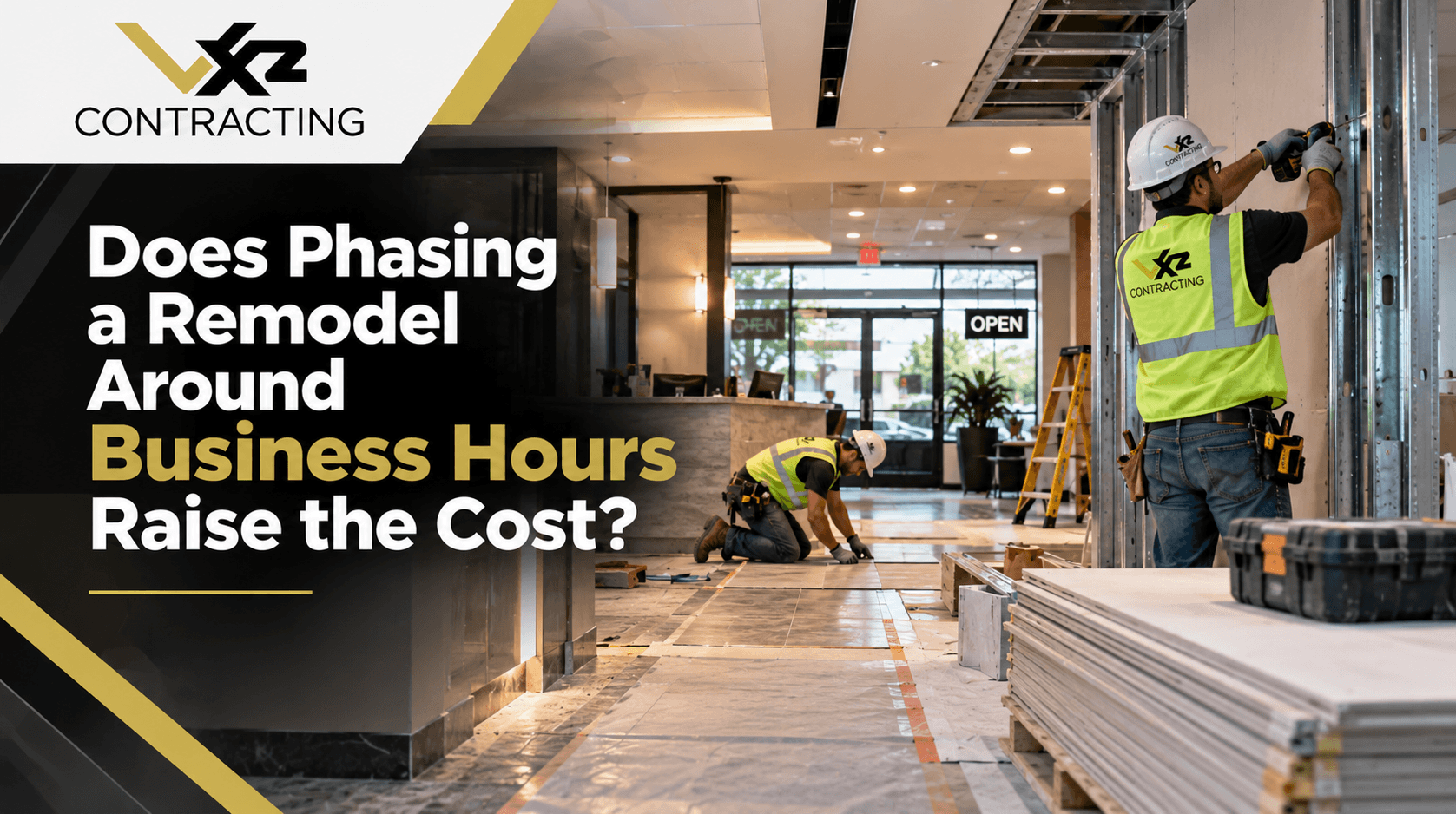
Phasing means breaking a remodel into separate stages so that part of your space stays open and functional while another part is under construction. Instead of handing the contractor the keys to the whole building, you hand over one zone at a time.
A phased project might divide a building by area, such as finishing the front sales floor before moving to the back offices. It might divide by time, with crews working evenings, overnight, or weekends when the business is closed. Many projects combine both approaches, with noisy demolition happening after hours and quieter finish work happening during the day behind temporary walls.
Each phase is planned like a small project of its own. The contractor builds temporary separation, completes the work in that zone, cleans up, and hands the area back before moving to the next one. Done well, customers may barely notice construction is happening. Done poorly, the business suffers through months of dust, noise, and confusion.
Because each phase repeats certain setup and close-out steps, phasing adds work that a single continuous project wouldn't need. That's where the extra construction cost comes from.
Why Does a Phased Remodel Cost More to Build?
The premium for phasing isn't a markup for inconvenience. It reflects real labor, materials, and time that a contractor must spend to keep your business running safely during construction.
The most common sources of added cost include the following:
- Temporary barriers: Dust walls, plastic containment, zipper doors, and protective floor coverings must be built, maintained, and moved for each phase.
- After-hours labor: Evening, overnight, and weekend work often comes with premium pay rates for crews and subcontractors.
- Repeated mobilization: Each time crews set up and break down in a new area, they spend time moving tools, materials, and equipment.
- Longer overall schedule: Stretching work across phases means more weeks of supervision, project management, and site overhead.
- Daily cleanup: Spaces that reopen to the public each morning need a thorough cleaning every night, not just at the end of the job.
- Temporary utilities and life safety: Keeping lights, HVAC, exit paths, and fire alarm coverage working in occupied areas can require temporary connections or additional coordination.
When Does Phasing Save Money Overall?
The construction premium is only half of the equation. The other half is the cost of shutting down. For many businesses, the revenue lost during a full closure is far larger than the added construction expense of phasing.
Consider a busy medical practice that sees patients every day. Closing for a month means canceled appointments, lost billing, and patients who might find another provider. Paying more for a phased remodel that keeps exam rooms open can be the clearly cheaper option once that lost revenue is counted.
Phasing also protects relationships that are hard to put a dollar value on. Regular customers stay in the habit of visiting. Employees keep working and earning. Your business stays visible instead of going dark behind paper-covered windows.
On the other hand, a full shutdown can make more sense when the business has a natural slow season, when the work is so disruptive that operating would be unsafe or unpleasant, or when the space is small enough that phasing would leave too little room to function. The right choice comes from comparing the phasing premium to your realistic revenue loss, not from assuming one approach is always better.
How Should York, PA Businesses Plan a Phased Remodel?
York, PA has a varied commercial landscape, from downtown storefronts and restaurants to medical offices, light industrial facilities, and shopping centers along major corridors. Each type of business in York, PA brings different phasing challenges.
Downtown buildings in York, PA often share walls with neighbors and have limited loading access, so contractors must plan material deliveries and debris removal carefully, sometimes during off-peak hours. Shopping center tenants may need to follow landlord rules about construction hours, noise, and storefront appearance. Medical and healthcare spaces may need stricter infection control measures, such as sealed containment and negative air pressure, to protect patients.
Seasonality also plays a role. Retailers may want work completed before the holiday shopping season, while other businesses can take advantage of quieter stretches in late winter. Talking through these local timing factors with your contractor early helps a York, PA business build a phasing plan that fits its calendar instead of fighting it.
How Can You Keep Phasing Costs Under Control?
A phased remodel doesn't have to come with an open-ended premium. Good planning reduces the number of phases, the amount of after-hours work, and the risk of delays.
These steps help keep a phased project efficient and on budget:
- Define what must stay open. Identify the areas and functions your business truly can't operate without, so the contractor isn't phasing around spaces that could simply close.
- Minimize the number of phases. Fewer, larger phases reduce repeated setup, teardown, and temporary construction.
- Save after-hours work for disruptive tasks. Schedule demolition, cutting, and other loud or dusty work outside business hours, while quieter work happens during the day.
- Order materials early. Long-lead items like fixtures, doors, and ceiling systems should be on site before each phase begins to prevent work from stalling.
- Agree on a communication plan. Set a regular check-in so your staff knows what's happening each week and your contractor learns about scheduling conflicts quickly.
- Build in a realistic contingency. Phased projects in occupied buildings can uncover surprises, and having funds set aside prevents tough mid-project decisions.
Frequently Asked Questions
Do I need to notify my insurance company before a phased remodel?
It's a good idea to let your insurance agent know about construction in an occupied space. Your contractor should carry its own liability insurance, but your agent can confirm whether your business policy needs any adjustments during the project.
Can a phased project receive partial approvals from the building inspector?
In many cases, completed phases can be inspected and approved for occupancy before the entire project is finished. This depends on the scope and the local code official, so it should be discussed during permitting.
Will my customers need special signage during construction?
Clear signage helps customers find open entrances, restrooms, and checkout areas. It also reassures them the business is open, which is especially important when storefronts or parking areas are partially blocked.
How do contractors handle security during overnight work?
Contractors typically coordinate key access, alarm codes, and lock-up procedures with the owner before overnight work begins. Some businesses also have a staff member or security service present during after-hours shifts.
Can my employees stay productive in a building under construction?
Most employees can work normally if noisy tasks are scheduled carefully and work zones are well separated. Temporarily relocating desks or staff away from active areas can improve focus and comfort.
Conclusion
Phasing a remodel around business hours usually increases construction costs because of temporary barriers, after-hours labor, repeated setup, and a longer schedule. For many businesses, though, that premium is smaller than the revenue lost during a full shutdown. Careful planning, fewer phases, and smart scheduling keep the extra costs reasonable.
Vx2 Contracting regularly works in occupied commercial spaces throughout South Central Pennsylvania and plans projects to keep disruption to a minimum. If you're thinking about remodeling without closing your doors, reach out to discuss a phasing plan that works for your business.